

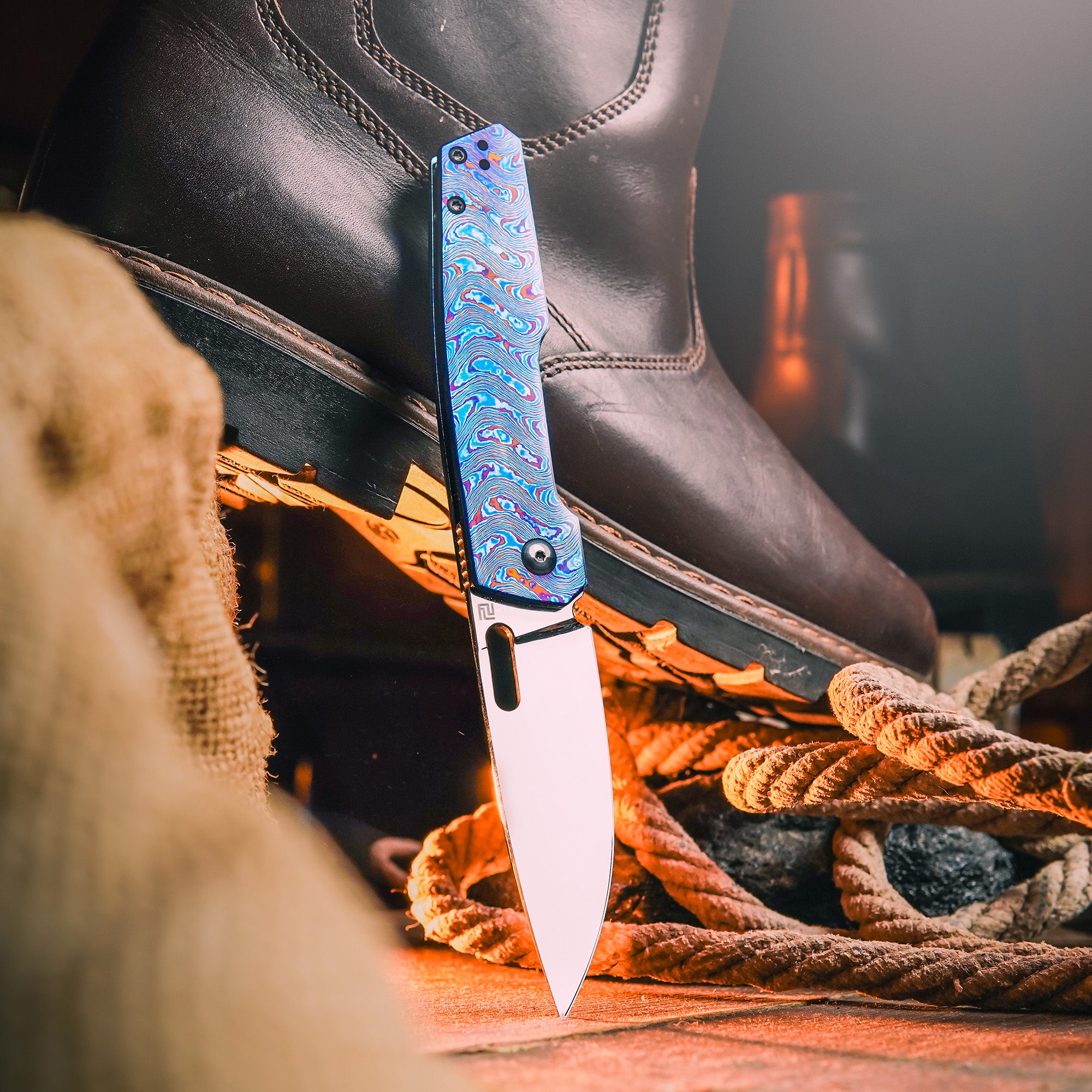
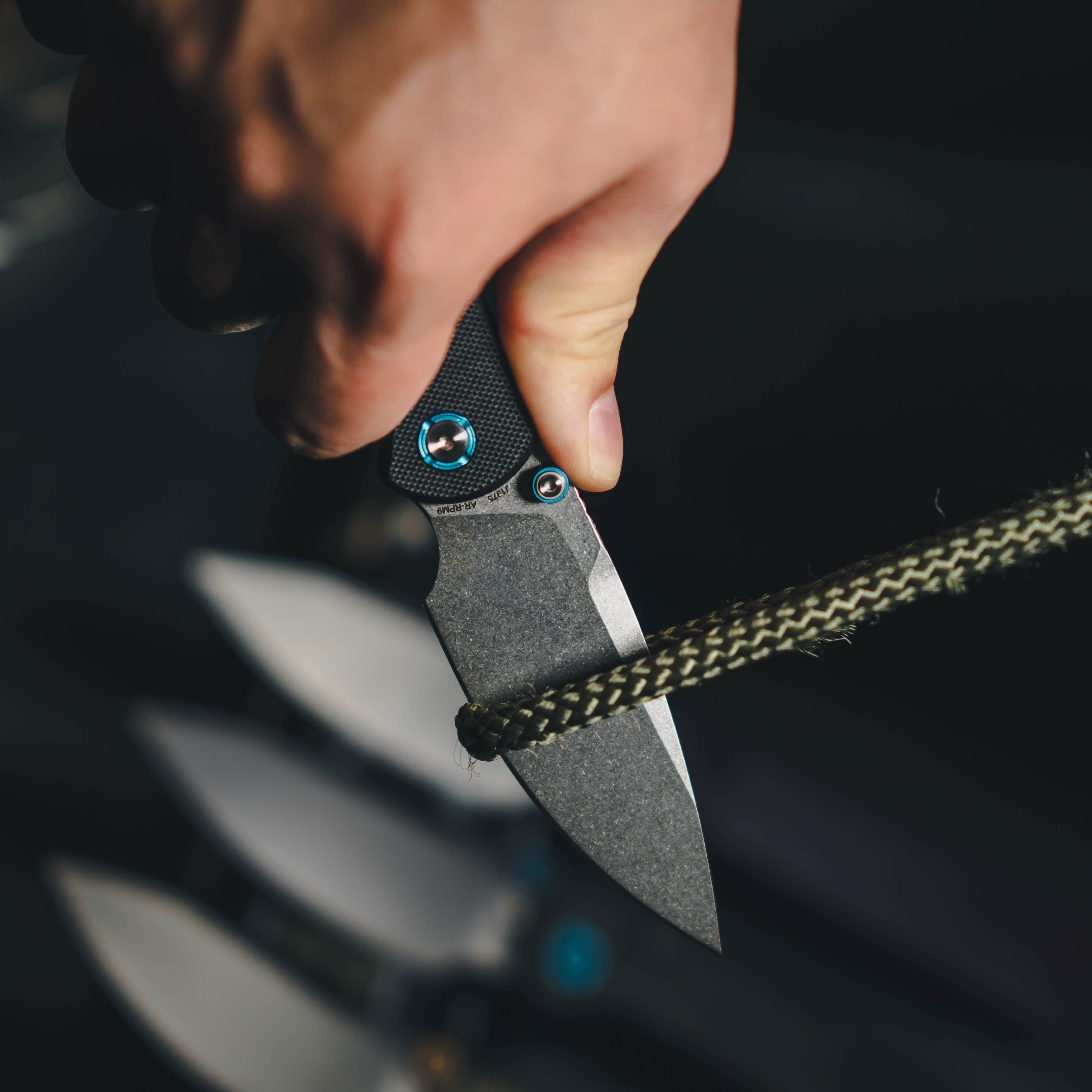
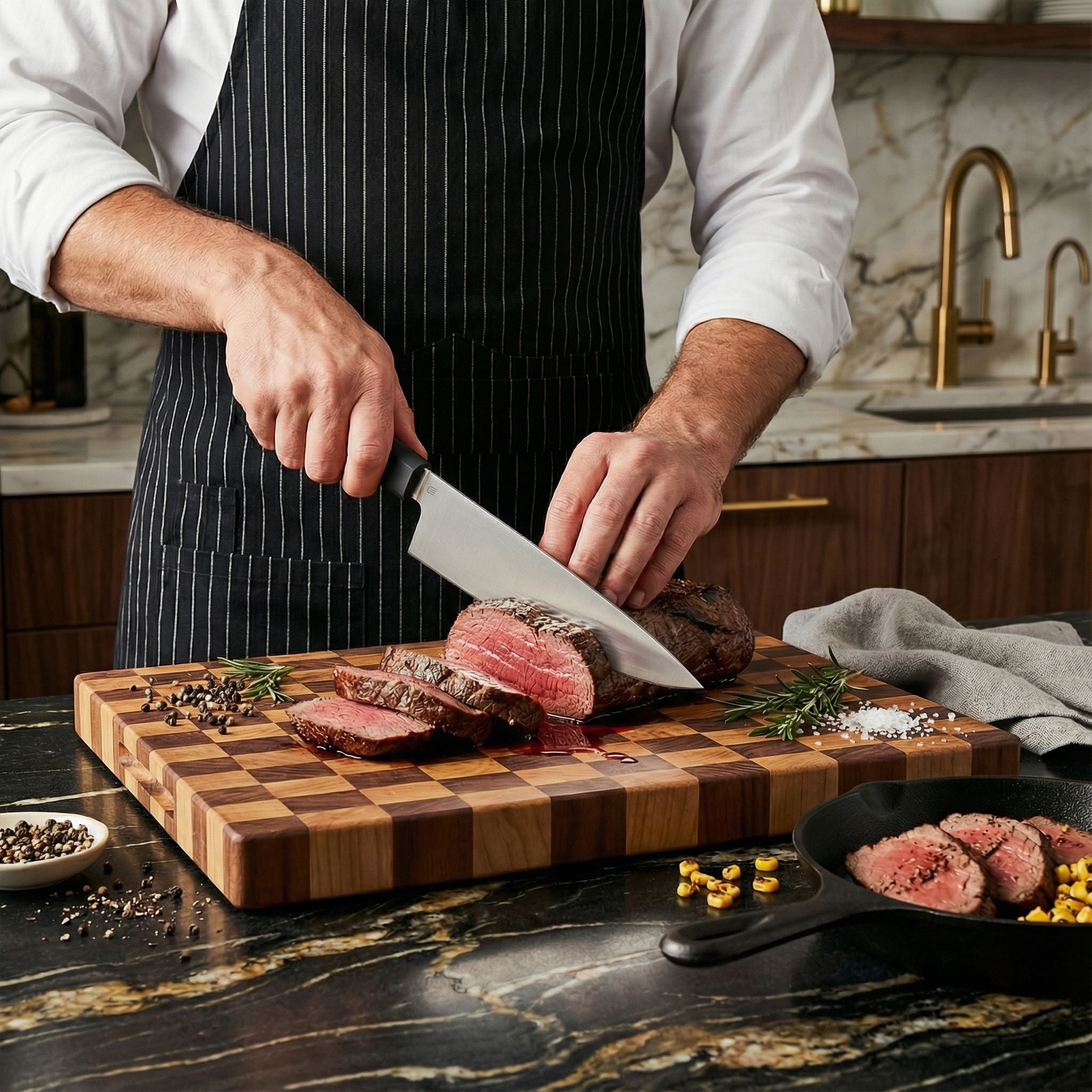

Few Artisan Cutlery model names cover as much ground as the Osprey. The family is built around one signature idea — a cleaver-style blade that Artisan describes as excelling at cutting, chopping, and slicing — and that idea is offered in no fewer than seven live configurations: titanium frame-lock folders in S35VN, M390, and Damascus, value D2 liner-lock folders in G10, and even a fixed-blade version of the same cleaver. Prices run from $52.49 to $224.99, which makes the Osprey one of the widest price spans in the catalog.
Handle materials and colorways divide the Osprey family into seven distinct configurations.
Because every Osprey shares the same blade philosophy but changes steel, handle, and lock around it, the family is easy to misread from a single product page. This buying guide sorts every current configuration with specifications taken directly from the Artisan Cutlery product listings, so you can match the right Osprey to your budget and carry style.
The Cleaver-Style Osprey Blade
The Osprey's defining feature is its blade geometry. Artisan describes the profile as a cleaver-style blade, with a short, solid shape that puts weight and edge behind chopping and slicing tasks while keeping the knife compact enough for everyday utility work. The special-pattern S35VN build describes the balance as weight-forward, making it an outstanding chopper while the upswept edge keeps it a capable slicer.
That is an honest description of the tradeoff: a cleaver-style blade is not trying to be a delicate detail cutter. It is a tool that wants to bear down on food prep, cardboard, rope, and camp chores, and the Osprey's thick 0.15-inch stock and flat grind back that up with real stiffness.
Every Artisan Cutlery Osprey at a Glance
| Model | Steel / hardness | Blade | Handle / lock | Weight | Price |
|---|---|---|---|---|---|
| 1803G S35VN | S35VN, HRC 59-61 | 3.74in (95mm), satin | Titanium TC4, frame lock | 6.0oz (170g) | $187.49 |
| 1803G M390 | M390, HRC 60-62 | 3.74in (95mm), satin | Textured titanium TC4, frame lock | 6.0oz (170g) | $224.99 |
| 1803GD Damascus | Damascus, HRC 60-62 | 3.74in (95mm) | Titanium TC4, frame lock | 6.0oz (170g) | $187.49 |
| 1803G special pattern | S35VN, HRC 59-61 | 3.74in (95mm), satin | Titanium TC4, frame lock | 6.0oz (170g) | $199.49 |
| 1803P G10 | D2, HRC 59-61 | 3.94in (100mm), stonewash | G10, liner lock | 6.0oz (170g) | $52.49 |
| 1803P G10 curve | D2, HRC 59-61 | 3.94in (100mm), stonewash | Contoured G10, liner lock | 6.0oz (170g) | $59.24 |
| 1803B fixed blade | D2, HRC 59-61 | 3.94in (100mm), stonewash | G10, no lock | 6.0oz (170g) | $57.13 |
Two details in this table matter for real-world buying. First, the folding Ospreys all open on a ceramic ball-bearing pivot, regardless of price tier, so the action quality carries across the whole family. Second, the D2 versions actually carry a slightly longer blade (3.94 inches versus 3.74 inches on the titanium folders), which makes the budget Osprey the biggest cutter of the lineup on paper.
Reading the Model Codes: G, GD, P, and B
The Osprey model numbers follow Artisan's standard code system, and decoding them makes the family instantly readable.
- 1803G is the premium series: titanium TC4 handles with a titanium clip, a frame lock, and premium blade steels. The M390 and special-pattern S35VN builds live here, alongside the base S35VN version.
- 1803GD marks the Damascus blade version of the G series — the same titanium frame-lock platform with a pattern-welded blade at HRC 60-62.
- 1803P is the value series: D2 steel with G10 handles and a liner lock, priced for everyday carry. The flat-scale and contoured-curve versions are the two handle shapes offered.
- 1803B is the fixed-blade Osprey: the same cleaver-style D2 blade in a no-moving-parts G10 build with a stainless steel pocket clip.
Once you know that pattern, the whole family sorts itself: G for titanium premium, GD for Damascus, P for G10 value, and B for fixed blade.
Steel Tiers: D2, S35VN, M390, and Damascus
The Osprey family spans the full Artisan steel ladder, and your choice of steel should follow your sharpening habits and your use case.
- D2 is the high-carbon tool steel powering the budget folders and the fixed blade. It takes a keen edge and holds it well, but it is not fully stainless, so it asks for a little care in wet climates. Our D2 care guide covers rust prevention and maintenance, and D2 steel on Wikipedia explains the metallurgy.
- S35VN is the Crucible powder stainless that anchors the titanium Ospreys. It balances edge retention, toughness, and corrosion resistance, which is exactly what a do-everything EDC blade needs. The Crucible Industries page covers the maker, and our S35VN steel guide goes into the performance profile.
- M390 is the top of the ladder: a Böhler powder stainless famous for very high edge retention and strong corrosion resistance. On the Osprey it runs at HRC 60-62 and costs a $37.50 premium over the S35VN build — a fair price for the longest-lasting edge in the family. Our M390 guide explains why it is the reference super steel.
- Damascus is the showpiece option: pattern-welded steel with layered structure visible in every blade, heat treated to HRC 60-62 on the 1803GD. If you want the striking look, our Damascus buying guide explains what pattern welding is, and Damascus steel on Wikipedia separates the history from the modern process.
For a broader frame of reference on how these steels compare, the knife steel overview on Wikipedia is a dependable starting point.
Frame Lock vs Liner Lock vs Fixed Blade
Osprey buyers effectively choose among three lock arrangements, and each maps to a different price tier.
The frame lock on the titanium models uses one handle scale itself to lock the blade open — the premium EDC standard for its slim profile and solid lockup. The liner lock on the G10 models uses a spring-loaded steel liner inside the handle instead, which keeps weight and cost down while preserving one-hand closing. Both are proven mechanisms with decades of service history; Wikipedia covers the frame lock and the liner lock in detail, and our lock strength comparison addresses the durability question head on.
The fixed-blade 1803B has no lock at all, because it does not fold. A fixed blade removes every moving part from the equation, which makes it the strongest and simplest option for hard outdoor use, at the cost of a much larger carry footprint. If you are weighing the two categories, our folding vs fixed blade comparison walks through the practical differences.
Handle Materials and Colorways
The titanium Ospreys ship with TC4 titanium handles — textured on the M390 build — matched with a titanium pocket clip set for tip-up right or left carry. The G10 and fixed-blade versions use a stainless steel clip instead. Titanium brings corrosion resistance and a premium feel that wears beautifully; G10 is a fiberglass-and-resin composite that is tough, grippy, and indifferent to weather. Our G10 handle guide covers the material in depth.
Color is where the Osprey family gets fun, because every tier offers real choices:
- 1803G S35VN: blue, grey, rose, and mint green.
- 1803G M390: black, blue, gray, pink, and mint green on textured titanium.
- 1803GD Damascus: black, blue, grey, and green.
- 1803G special pattern: a distinct special-pattern handle, currently with only two in stock.
- 1803P G10: black, orange, and green on the flat scales; black and black-and-white on the contoured curve version.
- 1803B fixed: orange, red, and black G10.
Finishes: Satin vs Stonewash
Blade finish follows the price tier and is worth knowing before you buy. The titanium S35VN and M390 builds wear a satin finish — smooth, reflective, and handsome, but more inclined to show fine scratches with hard use. The D2 and fixed-blade builds are stonewashed, which leaves the blade with a matte, pebbled texture that hides wear extremely well. The Damascus 1803GD shows its pattern directly, with the layered steel doing the visual work. Our knife finish guide explains the tradeoffs between satin, stonewash, and coated finishes in full.
Quick Osprey Buying Answers
- Which Osprey is the cheapest? The D2 G10 folder at $52.49, followed by the fixed-blade 1803B at $57.13.
- Which Osprey has the best edge retention? The M390 build at HRC 60-62, the only Osprey in super-steel territory.
- Which Osprey is the biggest cutter? The D2 versions, whose 3.94-inch blade is longer than the 3.74-inch blade on the titanium folders.
- Is the Osprey lightweight? No — every version sits around 6 ounces (170 g). This is a full-size, weight-forward chopper-flavored EDC, not a featherweight.
- Is there a fixed-blade Osprey? Yes, the 1803B: a 3.94-inch D2 cleaver-style blade in G10 with a stainless steel clip.
Which Osprey Should You Buy?
- Budget everyday carry, under $60: the D2 G10 folder at $52.49, or the contoured G10 curve version at $59.24 for a more sculpted grip.
- Outdoor and camp use: the fixed-blade 1803B at $57.13 — no lock to fail, same cleaver DNA.
- Premium titanium frame lock: the S35VN 1803G at $187.49 in blue, grey, rose, or mint green.
- Maximum edge retention: the M390 build at $224.99, the flagship of the family.
- Collector piece: the Damascus 1803GD at $187.49, or the special-pattern S35VN while the two remaining units last.
Whichever tier you choose, you are getting the same cleaver-style blade philosophy, flat grind, and ceramic bearing pivot that define the Osprey name. Start with the S35VN titanium 1803G, compare the D2 G10 budget folder, or go straight for the fixed-blade 1803B.
Find your ideal everyday carry configuration — explore the Artisan Cutlery folding knife collection for premium EDC folders built for reliable everyday carry.

Leave a comment
This site is protected by hCaptcha and the hCaptcha Privacy Policy and Terms of Service apply.